For students and families living between North Macedonia and Slovenia, sending euros across borders is not an abstract financial topic. It can mean paying rent, receiving support from home, or understanding why one international payment costs more than another.
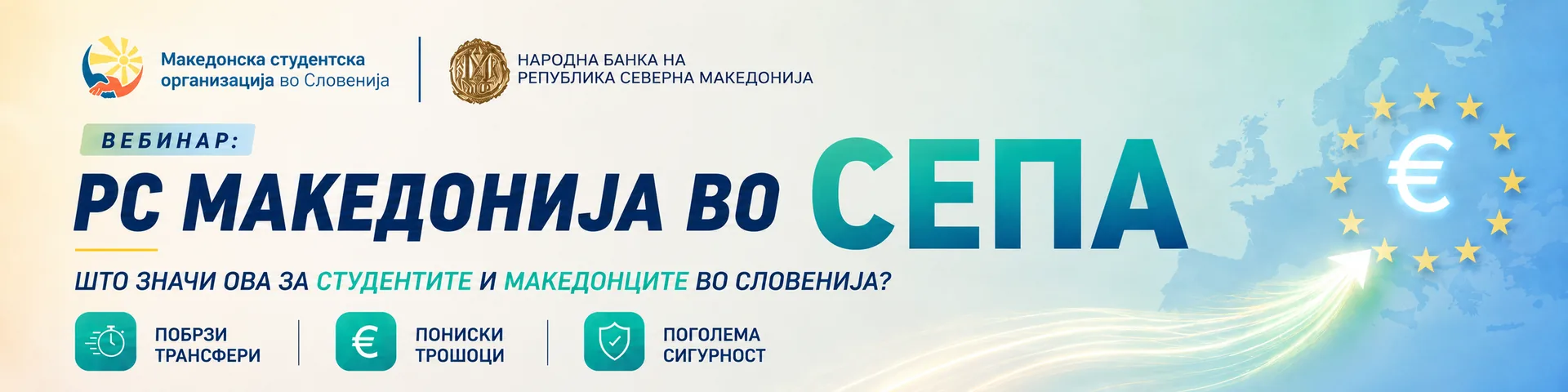
On 11 May 2026, MSOS joined the National Bank of the Republic of North Macedonia for an online webinar focused specifically on the practical side of SEPA.
Made possible with
The webinar was organised jointly by two partners. The National Bank of the Republic of North Macedonia served as co-organiser and expert partner, while MSOS acted as co-organiser and provided student community outreach.
Why SEPA mattered to our community
For students and families living between North Macedonia and Slovenia, sending euros across borders is not an abstract financial topic. It can mean paying rent, receiving support from home, transferring money between accounts, covering university-related costs, or simply understanding why one international payment costs more than another.
That is why MSOS joined the National Bank of the Republic of North Macedonia to organise a public webinar focused specifically on the practical side of SEPA.
North Macedonia became part of the geographical scope of the Single Euro Payments Area in March 2025, and Macedonian banks began joining the SEPA payment schemes later that year. This opened the way for faster, more standardised, and more cost-efficient euro transfers between North Macedonia and other SEPA countries, including Slovenia.
The aim of the webinar was to translate that institutional change into information people could actually use.
From the system to everyday payments
The main presentation was delivered by Anita Hegjkezi, Head of Section in the Payment Systems Directorate, and Miki Velichkovik, analyst at the National Bank of the Republic of North Macedonia.
Rather than focusing only on financial terminology, the session explained SEPA through the questions most relevant to citizens. Participants learned what joining the SEPA area changes, how euro transfers are processed, what users should expect from their banks, and which practical benefits may appear when sending or receiving money across borders.
For students in Slovenia, the topic was particularly relevant because many regularly interact with bank accounts in both countries. Understanding the system helps people compare transfer options, recognise the information their bank may request, and make more informed decisions when moving money between North Macedonia and Slovenia.
Questions from students and parents
The webinar concluded with an open question-and-answer session.
The 20 participants, including students and parents, were able to ask about the practical situations that matter to them directly. This was an important part of the format because changes in payment systems often become clearer only when they are connected to a real transfer, a bank account, or a specific problem someone has already encountered.
The session gave participants an opportunity to receive explanations directly from specialists working with payment systems at the National Bank, rather than relying only on fragmented information from banks, social media, or informal conversations.
Bringing expert information closer to students
The webinar reflected one of the ways MSOS can support students beyond social and community activities.
When a change directly affects everyday student life, the organisation can help connect the community with the institution that has the expertise to explain it. In this case, cooperation with the National Bank created a direct channel between students, families, and specialists working on the payment system itself.
For MSOS, the value of the event was not simply explaining what the abbreviation SEPA means. It was helping students understand how a major financial change can affect the practical reality of living between two countries.