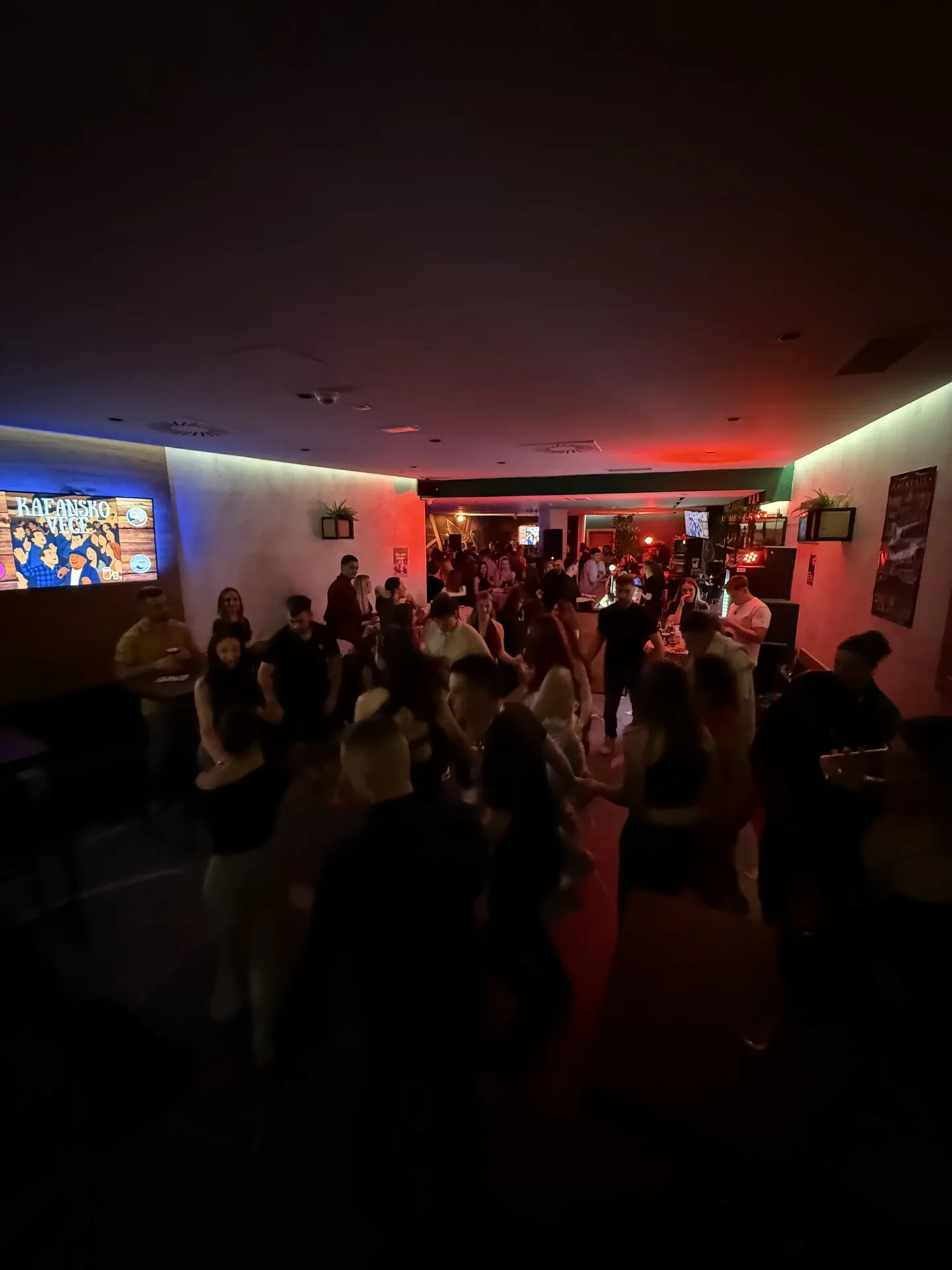
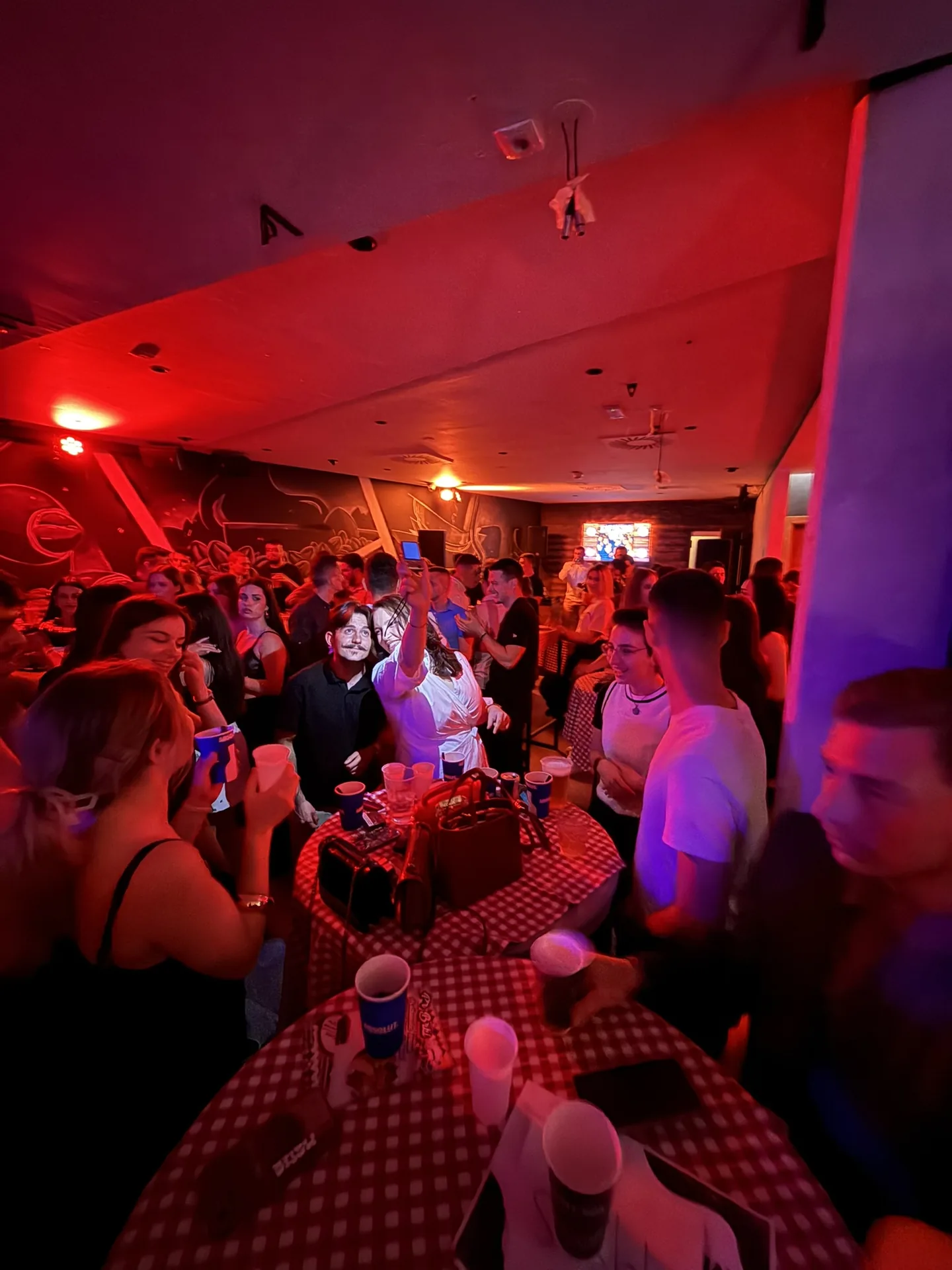
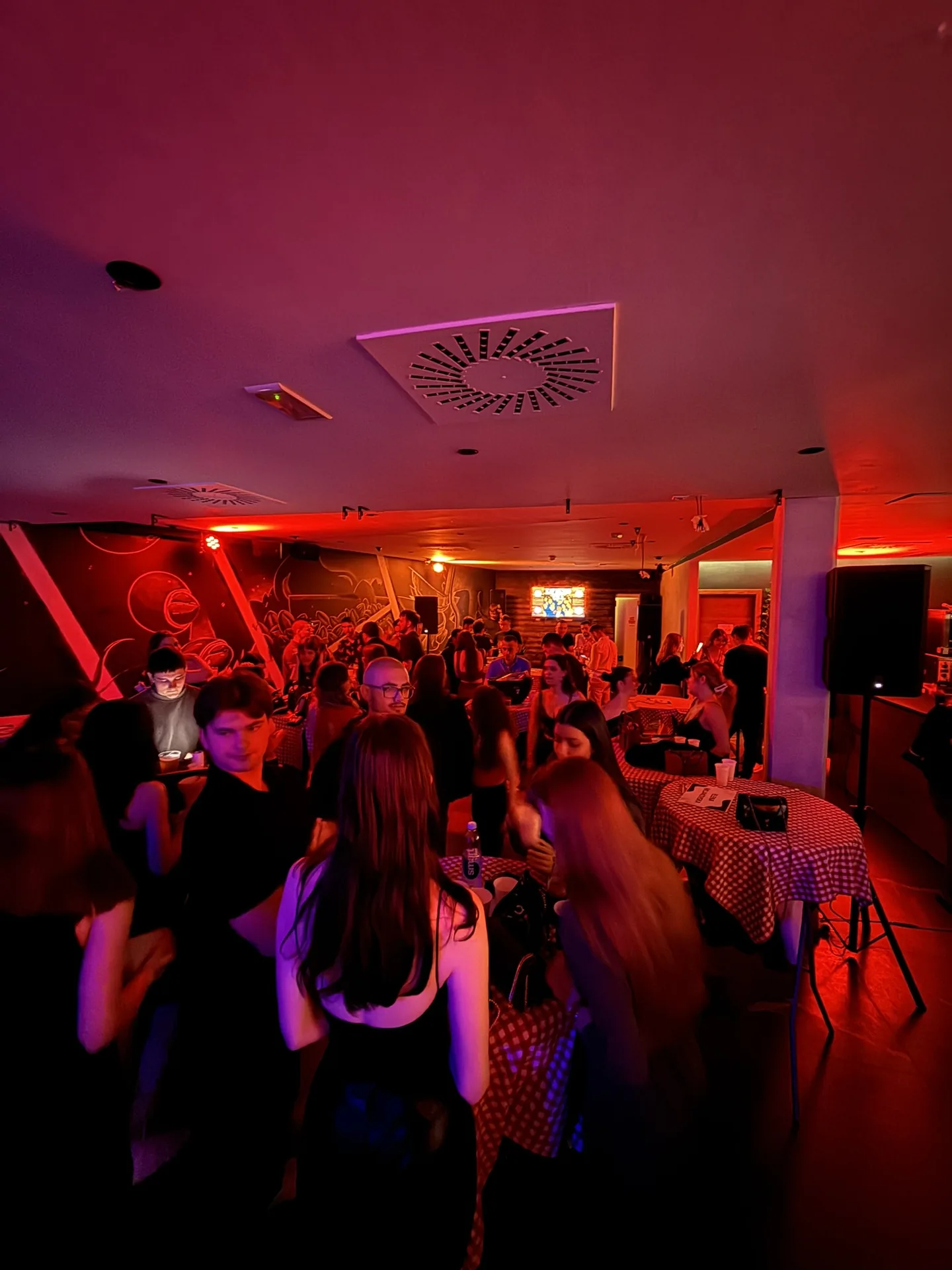
By the time the room filled, there was little distance left between the tables and the dance floor.
Under the red lights of AULA café, students stood between chairs, raised their hands and phones, and sang toward the musicians. Some had arrived with a reserved table and a full group of friends. Others moved between tables as the evening continued. Around 200 Serbian and Macedonian students attended Kafanska večer on 15 May 2025.
For MSOS, the evening was both a social event and a first opportunity to understand how this type of gathering could work within its own community.
Organised with
- STUDI: initiated the collaboration and led the main event organisation.
- SKC Pupin (Serbian Cultural Centre and Mihajlo Pupin Library): organising partner.
- Party Maniacs: event production and operational organisation.
- MSOS: community and promotional partner.
An invitation from STUDI
The collaboration began when Angelina Stojković from STUDI contacted MSOS with a proposal to join an event that their organisation already had experience producing.
The roles were clear from the beginning. STUDI, SKC Pupin, and Party Maniacs handled the main organisation, including the venue, band, table arrangements, ticket collection, finances, and operational details. MSOS joined as a community and promotional partner, sharing the event through its social channels and encouraging Macedonian students to attend.
The format made sense for two reasons. MSOS wanted to organise more activities together with regional student associations. The team had also discussed creating a Macedonian kafana evening, but had not yet tested the level of interest or the practical demands behind such an event. Joining an existing format offered a useful first step.
A room shaped by two student communities
The audience was mainly Serbian, with a visible Macedonian group participating throughout the evening. An internal estimate counted approximately 25 tables, around 20 occupied mainly by Serbian students and 5 mainly by Macedonian students.
Those numbers reflected the different sizes of the communities involved, but they also showed that Macedonian students were interested in the format. They did not attend only as observers. They joined the shared tables, songs, and movement across the room. The photographs from the evening capture this better than a formal attendance list could: the room is crowded, people are standing, hands are raised, and several students are recording the atmosphere on their phones.
When the tables stopped being boundaries
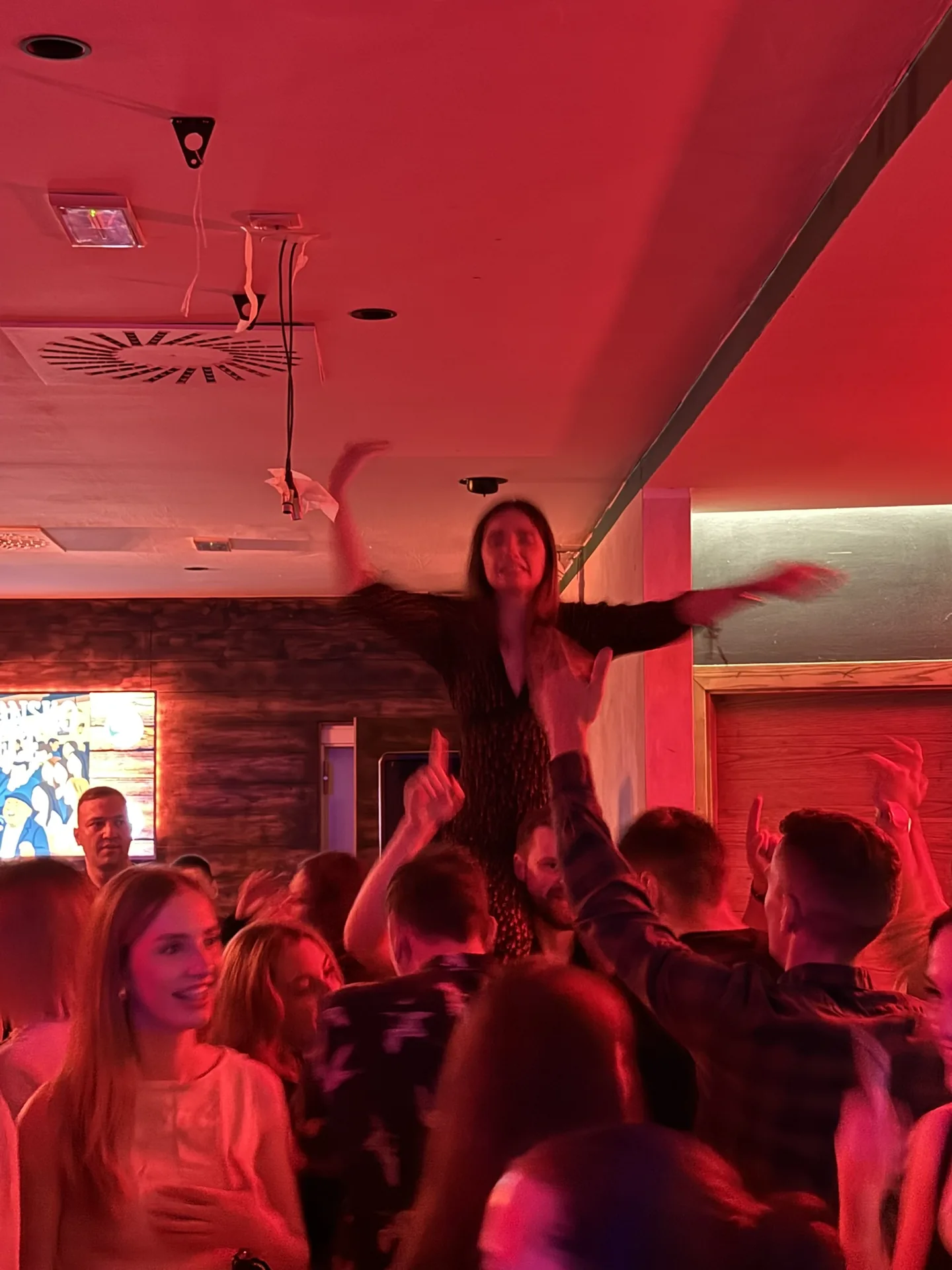
The defining part of the evening came once people no longer remained only with the groups they had arrived with. The tables had organised the room at the beginning. Live music slowly changed that structure.
Students stood up, moved closer to the performers, sang together, and crossed from one part of the venue to another. The evening created the type of atmosphere that had originally made MSOS interested in the idea: familiar music, an informal setting, and enough time for people to meet without a fixed programme directing every interaction. This was not a large MSOS production. The organisation's role was limited and transparent, yet the event still offered something useful to the community and to the team behind it. It showed that there was an audience for this type of night.
What MSOS learned from the collaboration
A successful public atmosphere does not mean that every part of the organising process is simple. The report prepared after the event highlighted several lessons for future collaborations. MSOS needs to be involved earlier and more directly when an event includes ticketing, contracts, financial planning, venue arrangements, band selection, and legal responsibilities.
Clear responsibilities are important, but shared oversight is equally important. For future events of this kind, the organisation wants to understand the complete process rather than participate only through promotion. That includes knowing how tickets are managed, how agreements are made, how budgets are planned, and how decisions are shared between partners. These are not details that appear in the photographs, but they are part of building stronger events.
A first answer to a future idea
Kafanska večer confirmed that students were interested in an evening built around live regional music and a relaxed social atmosphere. It also gave MSOS a clearer picture of what a future Macedonian kafana evening would require: stronger involvement from the beginning, fewer unclear responsibilities, transparent planning, and a format shaped directly around the Macedonian student community.
The night in AULA was therefore not only a well attended gathering. It was a practical first answer to an idea the organisation had already been discussing. The interest was there. The next step would be to build the format with greater ownership and a clearer MSOS identity.