
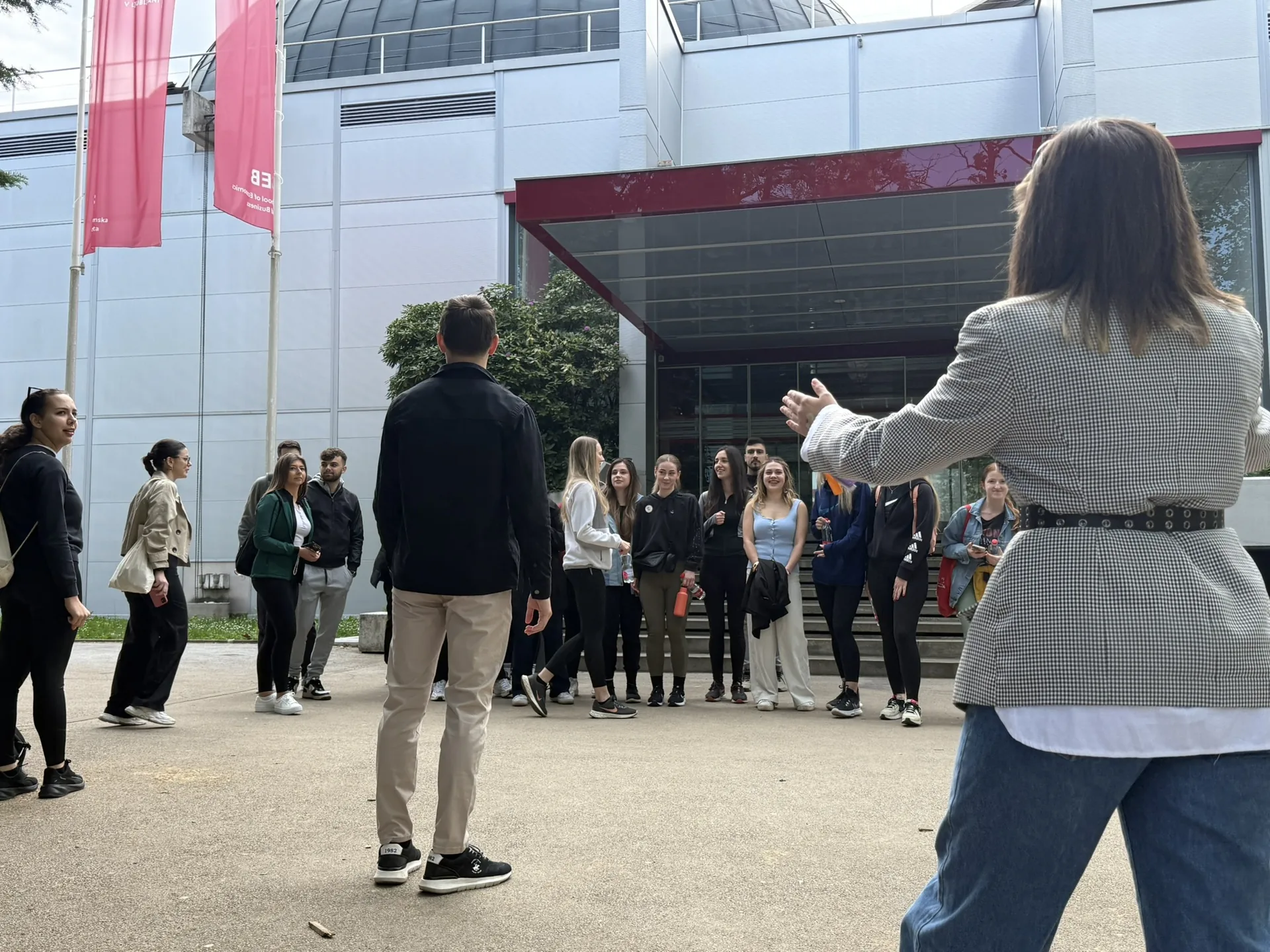
On Saturday morning, 24 students gathered outside the School of Economics and Business in Ljubljana.
Some already knew one another. Others were meeting for the first time. They came from Serbia, Bosnia and Herzegovina, Slovenia, Macedonia, Croatia, and Montenegro, but they had arrived at the same meeting point for the same reason: to begin the morning together.
From the faculty, the group headed toward the first checkpoint in Bežigrad and joined the 2025 Path Around the Wire. The walk itself was simple. The collaboration behind it was new.
Organised together by
This was the first event organised jointly by four student associations: the Macedonian Student Organisation in Slovenia (MSOS), STUDI (the Serbian student association in Slovenia), DBHSS (the Bosnian and Herzegovinian student association in Slovenia), and DHSS (the Croatian student association in Slovenia).
An idea shared between four associations
The event began one month earlier through an informal conversation between the presidents of four student associations. MSOS joined STUDI, DBHSS, and DHSS with one practical idea: create an activity where students from their communities could meet naturally, without a formal programme or a stage between them.
The Path Around the Wire offered the right setting. It was public, active, and open to everyone. Instead of inviting students into a closed venue, the associations could bring them together outside and begin with something as direct as walking in the same direction.
The organising team met online on 17 April to divide the work. Kristijan Popovski from MSOS prepared the shared registration form. Lena Bašić from STUDI and Klara David from DHSS worked on the event graphic. Eldar Talić from DBHSS contacted the Student Organisation of the University of Ljubljana regarding possible support with water. The event was then published on 5 May as a joint Instagram collaboration across the profiles of all four associations.
Six countries at one meeting point
The registration list showed the range of the group before the event even began. Ten participants registered from Serbia, six from Bosnia and Herzegovina, four from Slovenia, two from Macedonia, one from Croatia, and one from Montenegro.
The result was not a gathering built around one national community. It was a meeting between several student communities that already shared the same city, universities, and many of the same experiences of living abroad. That made the first minutes outside the faculty important. People arrived, found the group, spoke with someone new, and prepared to continue together.
From the faculty toward Bežigrad
At 08:45, the group left the meeting point and headed toward the Path Around the Wire checkpoint beside AMZS in Bežigrad. The official 2025 recreational route followed a 33 kilometre circuit around Ljubljana and allowed participants to begin at several checkpoints. For this MSOS collaboration, the confirmed shared activity was the gathering outside the faculty and the group movement toward the Bežigrad starting point.
This distinction matters because the event was not organised as a competition or a test of distance. Its purpose was to create a first shared experience between the associations and give their members an easy way to meet. Walking helped. Conversations could begin without being forced. Smaller groups formed and changed along the route. Students who arrived through one organisation could leave knowing people from three others.
A first activity with a clear next step
The organisers had set one main goal: connect the student associations and bring their members together through a shared event. The group achieved that with 24 participants, six represented countries, and no direct expenditure by MSOS.
More importantly, the four associations completed their first joint activity and agreed that it should not remain the last one. The event showed that cooperation did not always need a large stage, a complex programme, or a major budget. It needed a clear meeting point, divided responsibilities, communication between the teams, and an activity that gave people room to connect. On this occasion, that activity was a walk through Ljubljana. The path began outside one faculty, but the more important result was the new connection between four student communities.